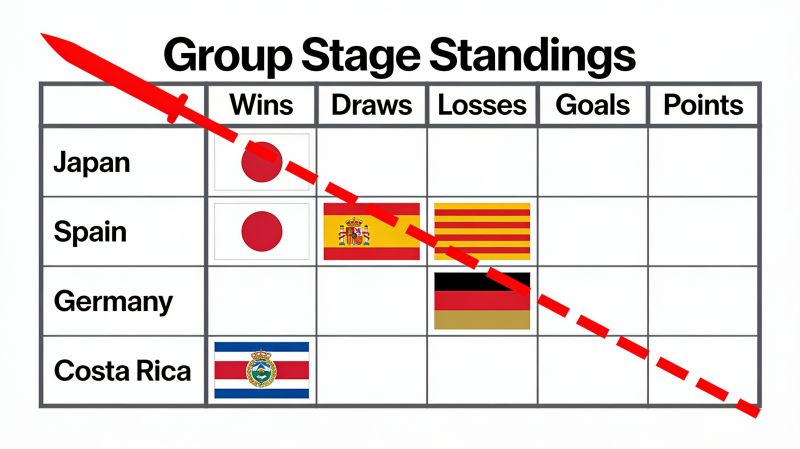
he World Cup Group E standings rarely tell the whole story. After two rounds of fixtures。the table shows Japan top on six points, Spain second on four, Germany third on one, and Costa Rica bottom with zero. But those numbers flatten the drama: Japan’s 2-1 win over Germany in Doha came from a tactical switch that pushed full-backs high and pinned Germany’s midfield;Spain’s 7-0 demolition of Costa Rica masked a defensive lapse that Japan exploited in a 2-1 comeback. Group E is not a procession. It is a knife-edge.Look at the goal difference column. Spain sit at +7, Japan at 0, Germany at -1, Costa Rica at -6. For Germany。the arithmetic is brutal. A win over Costa Rica on matchday three may not be enough if Japan take even a point from Spain. Germany need to win and hope Spain beat Japan, or win by enough goals to overtake Japan on goal difference. That is the kind of scenario that turns a final group game into a psychological puzzle. Germany’s coach has already talked about “controlling the controllables” but controlling goal difference against a Costa Rica side that defended deep against Spain is easier said than done.Japan’s position is stronger than most pundits predicted. Six points from two games is not a fluke;their substitutions against Germany changed the game’s tempo。and their press against Costa Rica forced turnovers in wide areas. The concern is squad depth. Japan’s starting eleven has logged heavy minutes, and Spain’s possession game will test their legs. If Japan sit deep and counter, they could nick a draw. If they try to match Spain pass for pass, they risk a repeat of Costa Rica’s collapse. That tactical choice will define the World Cup Group E standings more than any other single decision.
Spain’s 7-0 win over Costa Rica was impressive but misleading. Costa Rica’s back line stepped up too slowly, and Spain’s midfield runners exploited the space repeatedly. Against Germany, Spain created chances but conceded late in the first half. That vulnerability matters. Japan’s wide forwards are quick, and Spain’s full-backs push high. A single turnover could flip the group. Spain need only a draw to advance。but a loss to Japan could drop them to second if Germany win big. The World Cup Group E standings are tight enough that Spain cannot afford to treat the Japan match as a training exercise.What stands out is how little separates these teams in open play. Germany have created more expected goals than Japan but have fewer points. Costa Rica have been outshot heavily but still have a theoretical path to the knockout stage if they beat Germany and Spain beat Japan. That scenario is unlikely。
but it is mathematically alive. Group E has become a study in fine margins: a deflected shot, a missed clearance, a substitution made five minutes too late. The final standings will not just reflect talent. They will reflect which coach reads the game best under pressure. My hunch is that Japan’s flexibility gives them the edge, but I would not bet against Germany finding a way to make the final matchday uncomfortable for everyone.